
How to Search Criminal Dockets
Start with the free Wisconsin Circuit Court Access portal, usually called WCCA or CCAP. It holds public Oconto County criminal case summaries. Pick Oconto from the county list. A case number works best if you have one. Without it, search the party-name fields the portal allows, then check case type, filing year, party role, court branch, and status before trusting any result. A name that looks right is not proof of a match, so compare those details with care.
The portal is not the only way in. The Oconto County Clerk of Circuit Court keeps the official files and can help you find one at the Building C counter. Call 920-834-6859 with record questions. Written copy requests reach the clerk by mail, fax, the county-linked email form, or a drop-off in person. You may inspect records during regular office hours, within the limits the law sets on access.
- Open WCCA and choose the public circuit-court search.
- Select Oconto County and enter a case number or permitted name fields.
- Match the result by case type, year, role, and branch.
- Read activities, register entries, disposition, and status separately.
- Ask the clerk for the exact official document when the summary is not enough.
Oconto Criminal Case Number Clues
A Wisconsin case number tells you what kind of case sits behind it. felony filings carry a code like YYYYCF######, misdemeanors use YYYYCM######, and criminal traffic cases show YYYYCT######. The year plus the sequence number can separate docket entries that would otherwise blur together. Treat these as format cues only, not real case identifiers; the live WCCA result always controls.
CF marks a criminal felony, CM a criminal misdemeanor, and CT a criminal traffic case in circuit court, which is distinct from an ordinary municipal forfeiture.
A citation from a city or joint municipal court does not belong in an Oconto County criminal docket search. Those ordinance and traffic matters stay with that court's own clerk. An appeal is the one event that turns them into a circuit court case.
What a Criminal Docket Shows
Court staff enter every line of an Oconto County criminal docket, and the summary simply organizes it. Read each field for what it is. A charge is an allegation from the filing history. A scheduled activity is just a planned event, and neither entry proves guilt or shows what the court decided later.
| Case Number | Filing year, type code, and sequence identifying the matter. |
|---|---|
| Charge Entries | Public descriptions and statute references, which are accusations until resolved. |
| Court Activities | Planned initial appearances, pretrials, motions, sentencing, or trial. |
| Plea and Disposition | Separate fields that may show a plea, dismissal, acquittal, conviction, transfer, or other result. |
| Judgment and Status | Public judgment or sentence information and current summary status when available. |
Expect to see the judge, branch, party role, filing date, and dates for each register entry too. Still, a case appearing on the public docket does not promise you the complaint, any exhibit, an order, or a transcript.
Oconto Criminal Filings by the Numbers
County statistics for 2024 give a sense of scale without naming anyone. Oconto County logged 201 felony complaints filed, 160 misdemeanor complaints filed, and 86 criminal-traffic complaints filed, for a criminal total of 447 complaints filed and 452 cases opened. Dispositions ran 178 felony, 171 misdemeanor, and 89 criminal-traffic, or 438 in all.
Treat these numbers as workload counts, not tallies of people or guilt, and not one group of cases followed from start to finish. Transfers, reactivations, and older pending matters can pull the opened, filed, and disposed totals apart. Check the disposition on the individual case rather than guessing an outcome from annual totals.
Stages on a Criminal Docket
Staff at the courthouse add each filing and event, so the docket grows over time. A complaint opens the visible record. After that comes an initial appearance, then perhaps pretrial settings or motion hearings. Some Oconto County criminal cases end early. A plea, a dismissal, or another pretrial resolution can close the file. Others go all the way to a bench or jury trial, and a sentencing entry follows a conviction. Read what the entries actually say. The live record on the criminal docket beats any generic map. It shows how the case really unfolded.
Docket flow: Charge Filed › Initial Appearance › Pretrial and Motions › Plea or Trial › Disposition › Judgment or Sentencing
Court Activities are just that: scheduled events. They prove a date was set, not that anyone showed up. A later docket entry may reveal the hearing moved, was canceled, or produced an order. Want more depth on date checks? The Oconto County court calendar page walks through the details.
Oconto Court Activities Are Not Outcomes
The Oconto County Clerk points searchers toward Court Activities when they want upcoming events. That phrase is worth knowing locally, but treat it with care. An entry marked arraignment, pretrial, review, motion hearing, sentencing, or trial only names the setting. It says what was planned, no more. It says nothing about who appeared. It does not tell you what evidence came in or what the judge decided. So the court docket entry is a schedule line, not a result.
Read the sequence. Compare the planned activity with later register, disposition, and judgment entries. Recheck near the hearing because a date can change.
A docket summary can trail behind an order, and protected items stay off the screen. Want the precise account? Note the proceeding date and branch. Then ask the clerk about the order or transcript you need. Both Branch I and Branch II keep assigned court reporters. Transcript access runs through a separate process from WCCA.
Which Court Holds Criminal Dockets
Every criminal matter in Oconto County lands in Oconto County Circuit Court. That covers everything from a felony charge down to a criminal-traffic citation, and the court is one branch of Wisconsin's unified circuit-court system. The elected Clerk of Circuit Court keeps the court records. Both Branch I and Branch II sit at 301 Washington Street in Oconto. Walk into Building C, first floor, to reach the public clerk counter. Municipal courts work differently. Oconto, Oconto Falls, and Gillett Joint Municipal Court each take on local ordinance cases. Those courts also handle traffic, parking, and forfeiture matters. Paying a municipal fine through a city payment page is not the same as a WCCA docket search. If you appeal, the case moves to circuit court. There it gets a trial de novo under Wis. Stat. section 800.14. Federal criminal cases never touch WCCA. Those run through PACER in the Eastern District of Wisconsin.
Requesting Oconto Criminal Court Documents
WCCA shows docket entries, not case documents. Need the complaint, judgment of conviction, motion, or transcript? Start with the case number and name the item you want. The Oconto County copy instructions spell out four ways to order. You can use mail, fax, an email form, or a visit. Mail the request to Oconto County Clerk of Courts, 301 Washington Street, Oconto, WI 54153. Fax it instead to 920-834-6867. Copies cost $1.25 per page, and certification adds $5 per document. Mailing runs $2. Call the clerk for the current total before you pay. Tuck a self-addressed stamped envelope into a mailed request. Browsing court records at the office during normal hours is free. One more thing: only the county endorsement and seal make a copy certified. A WCCA printout carries neither.
Public Access and Sealed Criminal Dockets
Wisconsin courts lean toward openness. But a criminal docket still holds material the law shields. Sealed, expunged, confidential, and protected content may be omitted or masked on WCCA. Victim and witness details, juror information, protected addresses, and similar private fields stay off limits. Never copy them. And remember that an empty search result does not prove a case never existed.
Key rules:
Wis. Stat. section 19.31 states Wisconsin's public-records policy.
Wis. Stat. section 19.36 addresses limitations and confidential information.
Wis. Stat. section 973.015 governs expunction in qualifying criminal matters.
Sealing can hide a single entry, one name, or a whole case. Expunction works differently, so don't treat the two as the same. Depending on the file, the clerk may hand over a redacted version, deny the request, or require a formal process.
WCCA's Oconto Summary Boundary
The official Wisconsin case-search explanation calls WCCA public circuit-court information. Underneath sits CCAP. The data you see is only a snapshot of the official record, never the record itself. Some older material never made it into the system. Optional fields may simply be blank. It tracks neither jail custody nor supervision either. The official WCCA search route below is the statewide entry point.
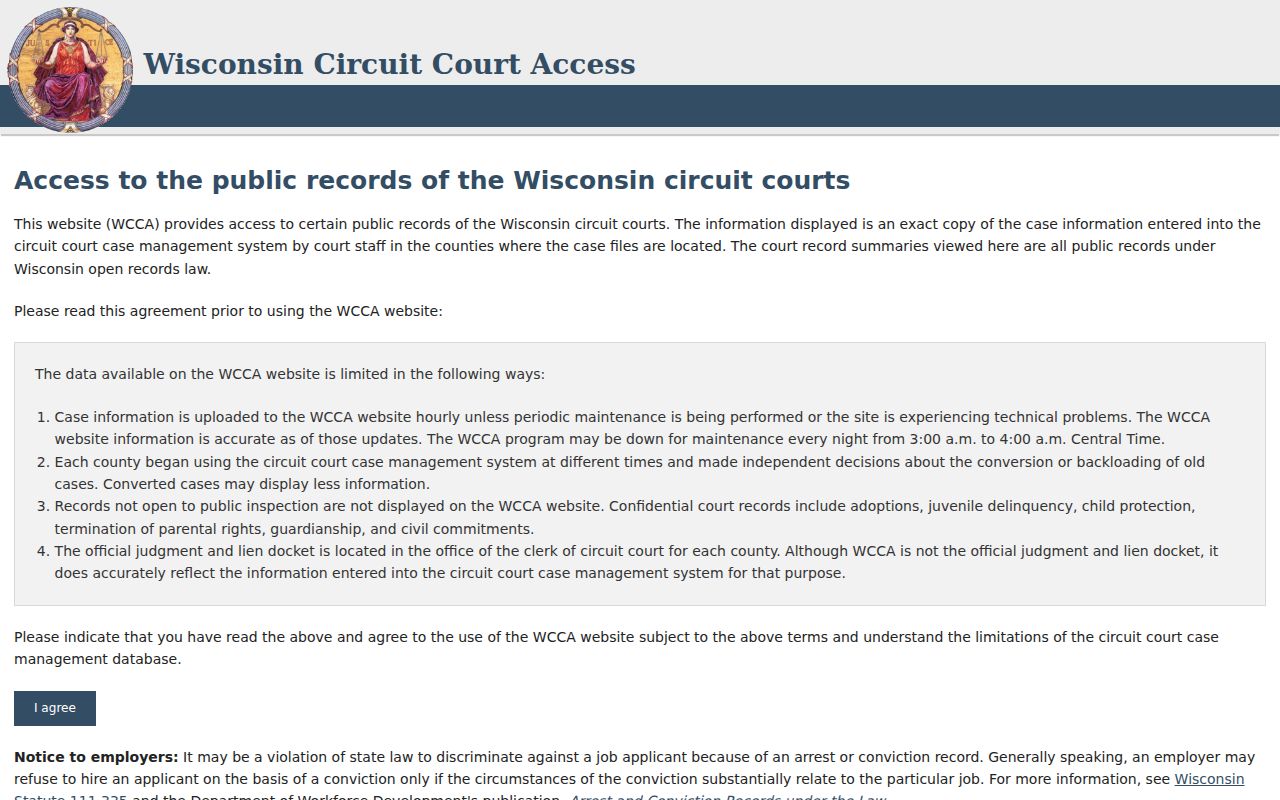
Narrow that screen by county and case type, and it becomes an Oconto County criminal docket search. Jot down the case number and the date you checked the result. Then take both to the clerk for the official record.
Oconto Charge and Disposition Checks
Reading a criminal docket well means telling the charge apart from the outcome. Begin with the filed charge and its statute. Then follow the trail forward through pleas, register entries, disposition, and judgment. Charges get amended, dismissed, tried, or settled through pleas. The first line rarely tells the story. A dismissal label alone can be misleading without the order behind it. Don't lean on an old event, a bond entry, or a sentencing date sitting on the calendar. That is not the final public disposition.
Confused by the wording? Save the Oconto County case number. Ask the Clerk of Circuit Court for the specific public judgment or order. Also know the limit. A public case summary says nothing about current custody, probation, or parole. Those statuses live with other offices and can shift after any docket entry. Keep the docket to what the court recorded. That keeps you from claiming more than the source supports.